Who's online

There are currently 0 users and 4 guests online.

OCEANOGRAPHY


Lesson code: 
BO.ENB.6.26
Teaching Units: 
2
Credits (ECTS): 
3
Teachning (hours): 
2
Practical (hours): 
0
Laboratory (hours): 
1

Cognitive: Knowledge and understanding of physical, chemical, biological and geological processes and interactions in oceans and the seas focusing on recent achievements in Biological Oceanography. The students learn to apply the basic knowledge using systemic approach in order to explain and assess changes in different scales.

 
Affective: Awareness on protection and management of marine ecosystems.
 
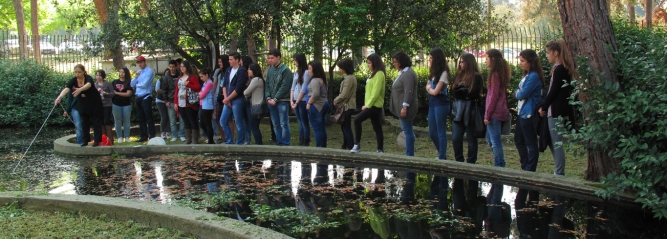
Skills: Use microscopical analysis of seawater, perform identification of particle categories, phytoplankton, zooplankton and macrophyte organisms. Measurement and estimation of primary productivity in the lab. Using bibliography, analysing, writing and presenting relative subjects (access to the electronic library of AUTH), working individually or in groups


Teaching Methods: 

Lectures, Tutorials, Assignments

Course Contents: 

How the Science of Oceanography developed, landmark achievements of Ocean Sciences. Geological processes and characteristics. Physical and chemical characteristics of seawater, physical and chemical processes Biological processes (productivity, food webs, microbial loop, phytoplankton blooms and marine snow). Biogeochemical processes (sources, production, transformations and transport of organic matter, element cycles, sources, transport and fate of pollutants). The role of the Ocean in the climate. 

Laboratory Exercises: 


1. Identification of particles and groups of planktic organisms in seawater (Moustaka M.)
 
2. Measurment of macrophyte primary productivity (Malea P.).
 
3. Written assignments concerning topics of specific interest(Υπευθ.: Moustaka M., Malea P.).


Recommended books: 

1. Albanakis K. 1999. Oceanography Lectures. University Studio Press.

2. Theodorou Α. 2004 Oceanography. Stamouli S. A..


Recommended reading: 
1. Moustaka-Gouni, 1997. Oceanography, A Biological Approach
 
 
3. CD-ROM Teaching lessons P. Malea. Given at the lesson.


Learning Activities: 

Attending lectures, performing specific assignments, practising technical or laboratory skills, writing papers, reading books and papers, working in groups

Assessment Methods: 

Oral and written examination, oral presentation, test, writing essays, report on labwork.

Blackboard / Website: 

-